 By Hemlata Soni
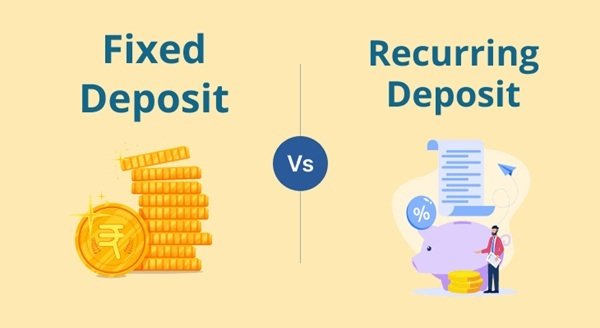
 Both Recurring Deposits (RD) and Fixed Deposits (FD) are among the safest and most widely used investment options in India. You’ll find them in almost every bank and post office. They don’t involve market risk, and they offer predictable returns.
But here’s the catch—they are designed for different types of investors.
One suits people who save gradually. The other suits those who already have a lump sum.
So before comparing, let’s understand each one properly.
What is a Recurring Deposit (RD)?
A Recurring Deposit is a savings plan where you deposit a fixed amount every month.
It’s built for discipline. You save little by little, and over time it turns into a decent amount.
How it works
You choose:
- A monthly deposit (₹500, ₹1000, etc.)
- A tenure (usually 6 months to 10 years)
Every month, the bank automatically deducts the amount and deposits it into your RD account.
At maturity, you get:
- Total invested amount
- Plus interest
Key features of RD
- Fixed monthly investment
- Fixed interest rate
- No market risk
- Suitable for salaried individuals
Where RD is useful
If you don’t have a large amount today but want to build savings slowly, RD is a great option.
It creates a habit of regular saving.
Where it feels limited
- Returns are moderate (similar to FD)
- Missing a payment may attract penalty
- Not ideal for large investments
What is a Fixed Deposit (FD)?
A Fixed Deposit is a one-time investment.
You deposit a lump sum and lock it for a fixed period.
How it works
You invest a single amount—₹10,000, ₹1 lakh, or more.
The bank gives a fixed interest rate for the chosen period.
At maturity, you get:
- Principal
- Plus interest
Key features of FD
- Lump sum investment
- Guaranteed returns
- Flexible tenure (7 days to 10 years)
- Option for monthly or quarterly interest payout
Where FD is useful
Perfect when you already have money and want safe returns.
Also useful for parking funds temporarily.
Where it feels limited
- Returns are fixed
- Doesn’t beat inflation significantly
- Requires upfront capital
Quick Comparison
| Factor | Recurring Deposit (RD) | Fixed Deposit (FD) |
| Investment Type | Monthly deposit | Lump sum |
| Minimum Investment | Low (₹500/month) | Depends on bank |
| Returns | Fixed | Fixed |
| Risk | Very low | Very low |
| Liquidity | Moderate | Moderate |
| Tenure | Fixed | Flexible |
| Best For | Regular savers | Lump sum investors |
| Interest Rate | Similar to FD | Similar to RD |
| Flexibility | Less (fixed monthly) | More options available |
Returns: Which One Earns More?
This is a common question.
FD usually gives slightly higher returns than RD.
Why?
Because in FD, the full amount is invested from day one.
In RD, money is added gradually. So interest is calculated on smaller amounts initially.
Example:
- FD: ₹1 lakh invested at once → full interest from start
- RD: ₹5000/month → money builds slowly
So overall maturity amount in FD is usually higher.
Risk and Safety
Both RD and FD are extremely safe.
- No market risk
- Guaranteed returns
- Backed by banks
Also, deposits up to ₹5 lakh per bank are insured in India.
So in terms of safety, both are equal.
Liquidity and Access
Neither is fully liquid, but both offer options.
RD:
- Premature withdrawal allowed with penalty
FD:
- Can break anytime (penalty applies)
- Can take loan against FD
FD is slightly more flexible here.
Discipline vs Convenience
This is where the real difference lies.
RD:
- Forces you to save monthly
- Builds discipline
FD:
- One-time investment
- No ongoing commitment
So RD is good for habit-building. FD is good for convenience.
Taxation
Both RD and FD follow the same tax rules.
- Interest is fully taxable
- Added to your income
- Tax depends on your income slab
Also:
- TDS may be deducted if interest crosses the limit
So no advantage here—both are taxed the same way.
Who Should Choose RD?
Recurring Deposit is better if:
- You don’t have a lump sum
- You want to save monthly
- You are salaried
- You want disciplined savings
- You are planning short-term goals
Examples:
- Vacation planning
- Buying a gadget
- Emergency fund building
Who Should Choose FD?
Fixed Deposit is better if:
- You already have a lump sum
- You want safe returns
- You want flexible tenure
- You need predictable income
Examples:
- Parking surplus money
- Retirement savings (for stability)
- Short-term financial goals
Real-Life Example
Let’s say you want to save ₹60,000.
Option 1:
- Invest ₹60,000 in FD → interest starts immediately
Option 2:
- Invest ₹5000/month in RD → money builds slowly
At the end:
- FD gives higher maturity value
But RD helped you save gradually without pressure.
Smart Strategy
You don’t have to choose just one.
A practical approach:
- Use RD to build savings
- Convert RD maturity into FD
This way:
- You build money step by step
- Then lock it for better returns
Final Verdict
There is no single winner.
If you have a lump sum and want better returns, FD is better.
If you want to build savings slowly and stay disciplined, RD is better.
Both are safe. Both are simple. Both serve different purposes.
The best choice depends on your current situation—not just returns.
And in many cases, using both together works even better.